
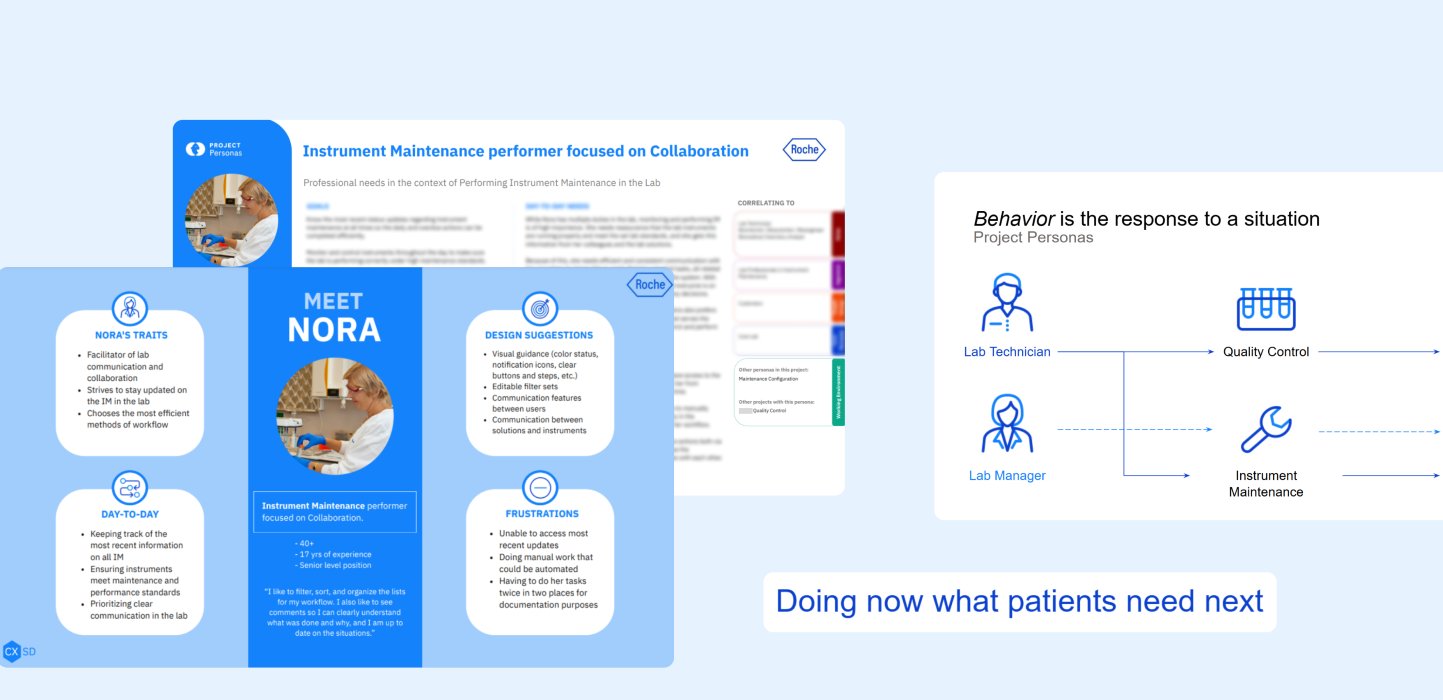
I used various research methods to help challenge a core UX assumption, leading to a new behavioral framework for complex products in a healthcare ecosystem.
Decision-guiding framework
changing how teams understand users
Department-wide
adaptable and reusable structure
Role
UX Researcher: Research planning, recruitment, roadmap, user interviews, prototype testing, team alignment, framework creation and adaptation
Team Members
1 Lead UX/UI Designer, 1 UX/UI Designer; In collaboration with the Research Department
Company
Roche
Context & Challenges
Users change behaviors in different situations
While conducting research for a department framework project, I noticed that many laboratory professionals interacted with several different pieces of Roche software and equipment throughout their daily workflows. Although our internal teams referenced shared Core Personas to support decision making, it became clear to us that the same user often approached different products with different goals, motivations, and behaviors.
Existing assumption:
Core Persona models treated users as static identities, where one persona = one user role.
New observations:
Behavior adapts across different workflows and products, where one user = alternating behavioral expressions and contexts.
Main Challenge:
If a single user can shift their own goals, behaviors, priorities, and context between products, can a single Core Persona accurately guide design decisions of a product?
Research
Evaluating Project Personas during user testing sessions
I considered and evaluated persona hypotheses during research and testing sessions with my design team’s products. Methods: Continuous Discovery with lab technicians and lab managers, moderated usability studies, formative evaluations, concept validation, global customer interviews, analysis of multiple products and workflows.
Top Insight #1
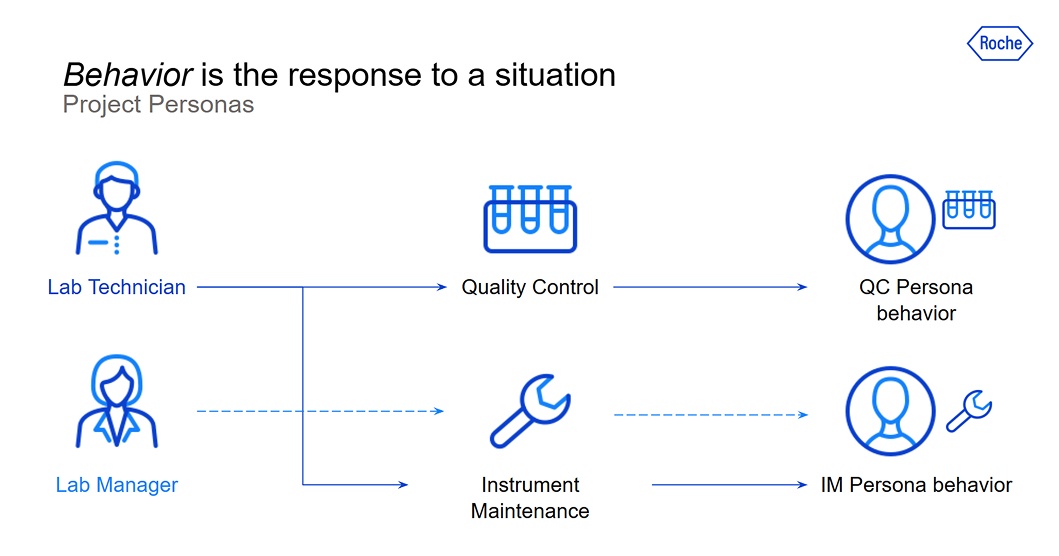
One user exhibits multiple persona behaviors during a single daily workflow
The same participant during various testing sessions shifted and adapted their behaviors and priorities when performing Quality Control versus Instrument Maintenance tasks.
Top Insight #2
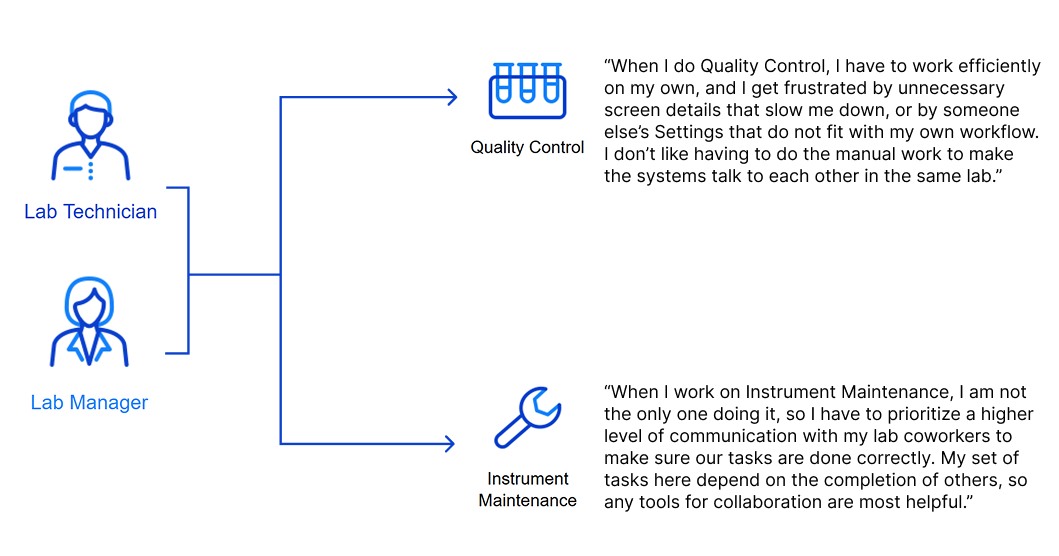
Different Core Personas change behavioral expressions for the same situational tasks
The Lab Technician and Lab Manager (Core Personas) both work on Quality Control (QC) and Instrument Maintenance (IM) equipment at different moments during the workflow. Their titles and main goals might differ, but their behaviors showed multiple crossovers due to the equipment of that situation.
Top Insight #3
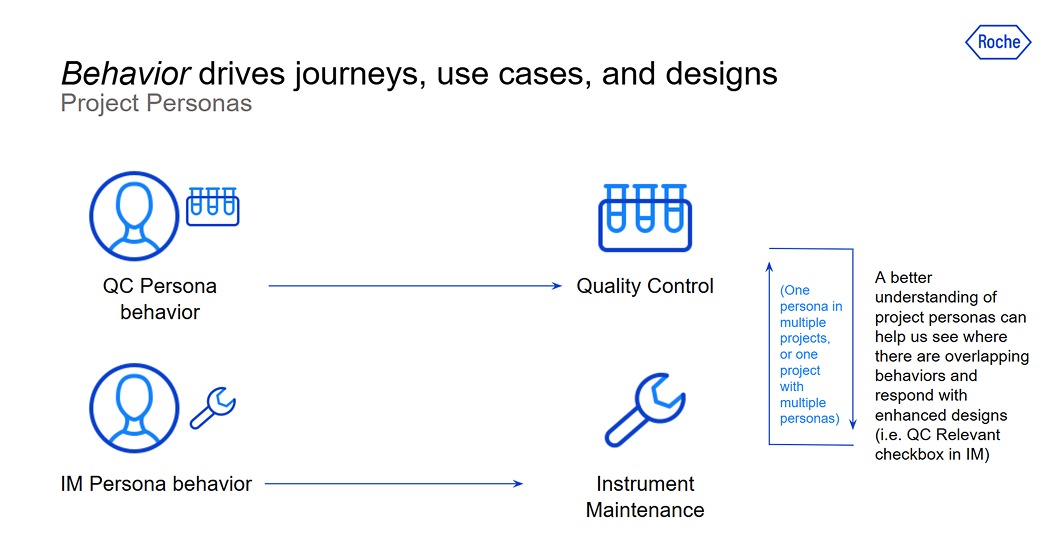
User design preferences depend more on task context than on their title or role
Prototype flow and design validation testings showed that participant perspectives on designs were more guided by the behavior of the task done with certain equipment/software than by the general behavior of their role on the lab team.
Product Realities
Considering all situational aspects
Designing equipment and software for blood analysis laboratories across the world requires specific attention to detail and unique considerations.
Multi-product ecosystem
Users move across several products to complete a single job.
Specialized workflows
Laboratory tasks require different mental models depending on context.
Healthcare environment
Recommendations needed to support accuracy, efficiency, and compliance.
Global customer base
Workflows varied across different country regulations and cultural laboratory environments.
Framework Design
Realigning how teams model users with how users actually behave
Using personas can help guide our research explorations and design recommendations, adding value to our product teams. In this approach, rather than asking who the user is, we shift to: What behavior is the user exhibiting within this workflow?
Key Decision #1
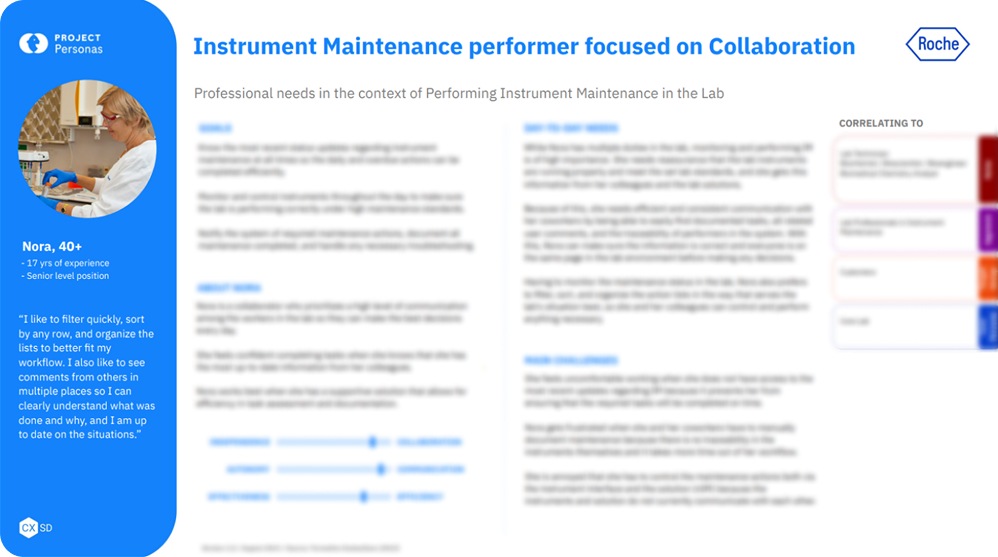
Integrate behavioral personas tied to workflows rather than roles on the design team
Here we dive deeper into their goals, priorities, daily needs, and task challenges. We understand their story in our lab context and we use that understanding to better formulate our research approaches and design suggestions.
Resarch-backed Reasoning
Traditional personas helped teams understand who users were. Redefining “Persona” moves us past any perspective constraints in analyzing the working environment and lab scenarios as an ecosystem. This enhancement in behavioral framework supports stronger research approaches and design soluctions for a more tailored experience in data-heavy lab contexts.
Balancing Trade-offs
Goal: Maintain consistency with existing Core Personas while introducing a new behavioral layer.
Key Decision #2
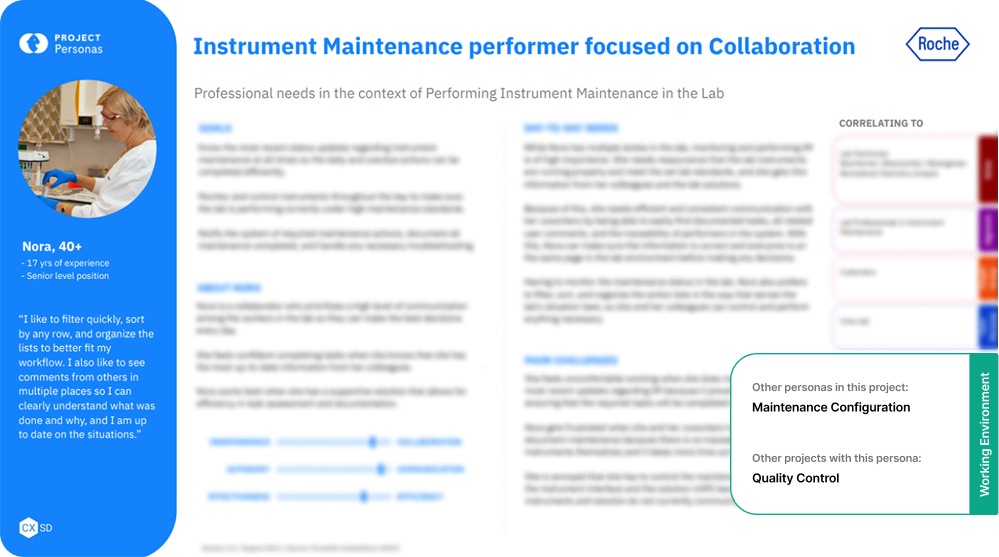
Add a Working Environment section
The Project Persona already had a section for correlating aspects, but it lacked showing relations between equipment and products in the lab environment. Adding a Working Environment section would make these connections more clear.
Resarch-backed Reasoning
This addition helps teams understand surrounding workflows and ecosystem influences. It aids us in:
- considering our other products/journeys they interact with and with which personas they share traits
- serving as a reminder internally of the importance of Ecosystem Mapping for high-quality user experiences
Balancing Trade-offs
Goal: Create enough detail to guide design decisions without overwhelming teams.
Key Decision #3
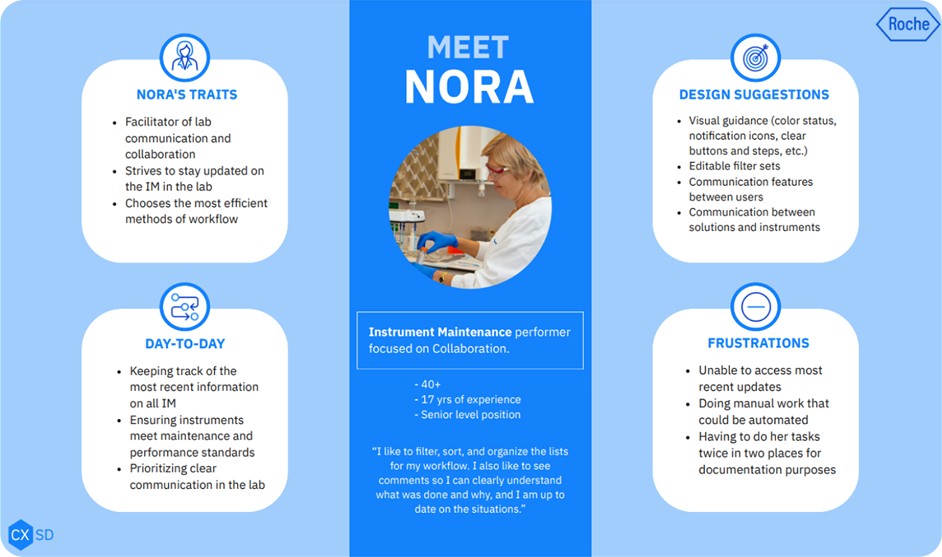
Create a Quick View version
In a Quick View cover page for the Project Persona, we can see a more concise version of the persona traits, day-to-day workflow, main design suggestion patterns, and top frustrations in carrying out their tasks.
Resarch-backed Reasoning
Researchers, designers, developers, and stakeholders all working on the same products need a lightweight version to reference internally. With each department bringing different perspectives, this Quick View creates a cross-functional base point. We might use different terminology carrying out our tasks, but we can still find common ground when speaking about our users.
Balancing Trade-offs
Goal: Support multiple product teams while keeping the framework adaptable.
Outcome & Impact
Creating a more context-aware view of users
By modeling behavior at the workflow level rather than the role level, teams can make more targeted design and research decisions for specific product contexts.
Better representation of user behavior
The framework captured how the same user could exhibit different goals, priorities, and behaviors depending on the workflow being performed.
Stronger product understanding
Adding Working Environment context helped teams consider surrounding responsibilities, tools, and workflows when making design decisions.
Research that scaled beyond one study
Insights from continuous discovery and other UX research influenced a reusable framework that could support future research, design, and product initiatives.
Reflections
Design for ecosystems
Understanding the environments, responsibilities, and workflows surrounding a task often reveals opportunities that interface-focused research alone can miss.
Research as a strategic tool
Research can shape how teams think about users, not just validate product decisions.
Make framework insights accessible
Research is most effective when findings are adapted to the needs of different audiences, from researchers and designers to stakeholders and development teams.
Value in Continuous Discovery
Different methods and approaches often uncover problems beyond the scope of the original study.